MAGAZIN.
SPACE FOR CONTEMPORARY ARCHITECTURE.Rembrandtstraße 14/1A
1020 Vienna, Austria
EXHIBITIONS
3D SCANS OF EXHIBITIONS
ABOUT US
SIGN-UP FOR NEWSLETTER
We are open
on Saturdays from 3-6 pm
and on appointment
Find out about all events and the most recent updates on ︎
We would like to thank for their support:

Blobsters, Slop and Hyper-Events: synthetic images as Deep Reality generators.
a lecture by
Martyna Marciniak
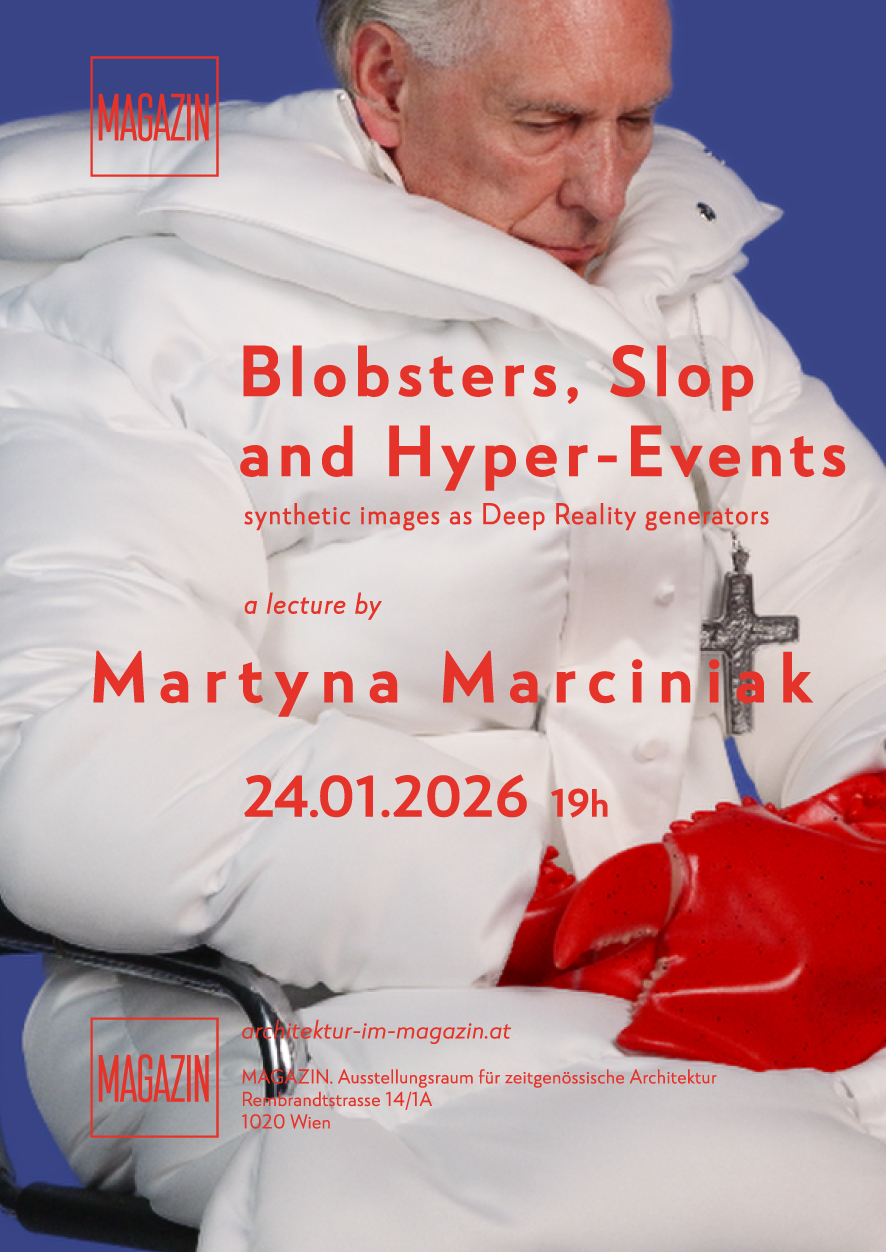
Blobsters, Slop and Hyper-Events:
synthetic images as Deep Reality generators.
In early 2023 a series of highly realistic synthetic images produced by the newly advanced, generative tools marked the perceived ‘beginning of the end of visual truth’. Any image from now on would fall into one of the two categories: real or fake.
Identifying the fake, as the argument goes, would be our best defense against the possibility of a mass misinformation event. Yet, could there be a value in staying with ‘the fake’? Could an in-depth analysis of the nonsensical reveal valuable truths about our collective beliefs, misconceptions and imagination?
In her talk Martyna Marciniak will unpack the complex landscape of synthetic image misinformation using a collection of images from 2018 until now, by applying strategies informed by her spatial forensic practice and a deep fascination with glitches and errors. Entering a dialogue with ‘Mirrorworlds’ she will provide a reading of the synthetic images not only as deep repositories of technical and cultural knowledge, but also as co-creators of ‘deep realities’ and devices for conjuring of hyperstitious, self-fulfilling prophecies.
The talk will trace the modes of manufacturing belief or trust visually, informed by the catholic church aesthetics, media history and technomyths.
Countering the prevailing dichotomy of the ‘real vs fake’ (an unwelcome gift of post-Trumpian parlance), the talk will employ a project-specific lexicon, carefully identifying the nuances of the synthetic and evidentiary images, while indicating their operational value and undoing the harmful anthropomorphisation of the popular AI concepts.
synthetic images as Deep Reality generators.
In early 2023 a series of highly realistic synthetic images produced by the newly advanced, generative tools marked the perceived ‘beginning of the end of visual truth’. Any image from now on would fall into one of the two categories: real or fake.
Identifying the fake, as the argument goes, would be our best defense against the possibility of a mass misinformation event. Yet, could there be a value in staying with ‘the fake’? Could an in-depth analysis of the nonsensical reveal valuable truths about our collective beliefs, misconceptions and imagination?
In her talk Martyna Marciniak will unpack the complex landscape of synthetic image misinformation using a collection of images from 2018 until now, by applying strategies informed by her spatial forensic practice and a deep fascination with glitches and errors. Entering a dialogue with ‘Mirrorworlds’ she will provide a reading of the synthetic images not only as deep repositories of technical and cultural knowledge, but also as co-creators of ‘deep realities’ and devices for conjuring of hyperstitious, self-fulfilling prophecies.
The talk will trace the modes of manufacturing belief or trust visually, informed by the catholic church aesthetics, media history and technomyths.
Countering the prevailing dichotomy of the ‘real vs fake’ (an unwelcome gift of post-Trumpian parlance), the talk will employ a project-specific lexicon, carefully identifying the nuances of the synthetic and evidentiary images, while indicating their operational value and undoing the harmful anthropomorphisation of the popular AI concepts.
24.01.2026 7pm
at MAGAZIN
Space for Contemporary Architecture
Rembrandtstrasse 14/1A, 1020 Vienna
The lecture takes place in the framework of the current exhibition MIRRORWORLDS by Paula Strunden.
Bring your sleeping bag—we’ll have an overnight dream session after the lecture.
Martyna Marciniak
Martyna Marciniak’s (PL/DE) practice bridges media theory, and legal imaginaries to trace how power inscribes itself through image regimes and visual infrastructures. Often revisiting historical events, her work engages in a form of pataforensics—poking at the tropes of scientific and forensic aesthetics, revealing their uncertainties, contradictions and lapses. Oscillating between sculpture, video and animation, she writes visual counter histories, and smuggles in other ways of seeing.
Her work has been shown by Onassis Stegi, Copenhagen Contemporary, Ars Electronica, Galerie Stadt Sindelfingen, Warsaw Biennale, LABoral Centro de Arte, among others. She is the 2025 CERN Collide resident. Her project ‘Anatomy of Non-Fact’ received the Award of Distinction Prix Ars Electronica in 2025.
https://www.martyna.digital/
Martyna Marciniak’s (PL/DE) practice bridges media theory, and legal imaginaries to trace how power inscribes itself through image regimes and visual infrastructures. Often revisiting historical events, her work engages in a form of pataforensics—poking at the tropes of scientific and forensic aesthetics, revealing their uncertainties, contradictions and lapses. Oscillating between sculpture, video and animation, she writes visual counter histories, and smuggles in other ways of seeing.
Her work has been shown by Onassis Stegi, Copenhagen Contemporary, Ars Electronica, Galerie Stadt Sindelfingen, Warsaw Biennale, LABoral Centro de Arte, among others. She is the 2025 CERN Collide resident. Her project ‘Anatomy of Non-Fact’ received the Award of Distinction Prix Ars Electronica in 2025.
https://www.martyna.digital/